

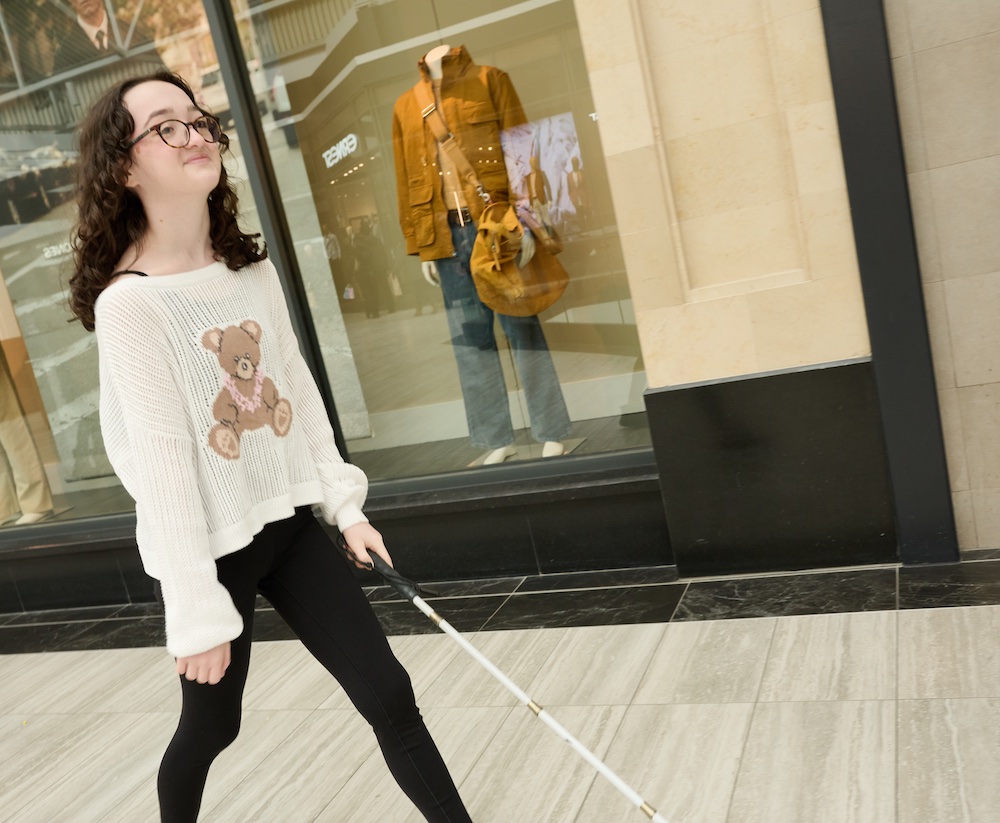
“But I can do it.”
That’s what I told my mom the day I decided I was going to take the bus to the mall by myself.
She was nervous. I don’t blame her. Because I’m legally blind, I can’t see the bus number. I can’t see the steps clearly. I don’t know which stop is coming up unless someone tells me. Staying on the sidewalk and crossing the street is also a big challenge.
But I really wanted to prove something — not just to her, but to myself.
And I did.
Thanks to the MAB-Mackay, I had practiced this. I had my white cane. I knew what questions to ask the bus driver. I knew my route. And I believed in myself. When I called her to say I’d made it safely, I don’t think I’ve ever felt prouder. It might sound like a small thing. But for me, it was huge.
Moments like that don’t just happen. They’re built over years of support — from specialists and from my family.
I was born with a rare eye condition called Axenfeld-Rieger Syndrome. Over time, it caused glaucoma and my vision kept getting worse. I’ve had more eye surgeries than I can count, starting when I was five. When I was 12 and in my first year of high school, things got especially bad. The pressure in my eyes had damaged my optic nerve. I completely lost my peripheral vision in one eye. Now, my “good” eye is 20/60 with glasses. My other eye is 20/8000.
I actually spent more time seeing doctors and having surgeries during grade 10 than anything else… I think I was only in school for 40 days. My glasses were barely making a difference too.
There were times when everything felt uncertain. Scary, even.
That’s when the MAB-Mackay became such an important part of my life.
At first, I didn’t even realize how much they could help me. But the more they got to know me, the more they started to offer support in areas that we never thought of. I remember someone came to our house to see how I was moving around. They helped us rearrange furniture, the pantry and fridge, and change the lighting so it would be brighter and easier for me.
But one of the biggest changes for me was learning how to use a white cane.
I didn’t want one at the beginning. I was embarrassed. I didn’t want to look different from everyone else at school. I was already tripping a lot, but I still resisted it.
Now I can’t imagine my life without my white cane.
My Orientation & Mobility specialist even blindfolded me during practice. It sounds scary, but it helped me trust my other senses. It was intense, but it gave me confidence. Now I don’t always have to rely on my mom. I have my freedom and can go places on my own.
The team also helped me get special equipment so I can still do things I love, like beading. They helped me manage the anxiety that comes with not always being able to see what’s around me. And they introduced me to a girl a little older who also has vision challenges. Meeting her made me realize I’m not alone, and that there’s still so much possible for me.
I’ll be graduating high school in just a few months. That feels exciting… and a little scary. Next year, I want to start CEGEP in nursing. I’ve spent a lot of time with nurses over the years, and they’ve made such a difference in my life. I want to be that person for someone else one day.
I know it won’t be easy with my vision. But I’m used to working hard. And knowing that the incredible team at the MAB-Mackay will be by my side, I feel a sense of comfort.
With gratitude,
Maya
16-year-old MAB-Mackay client